


Imagine This...
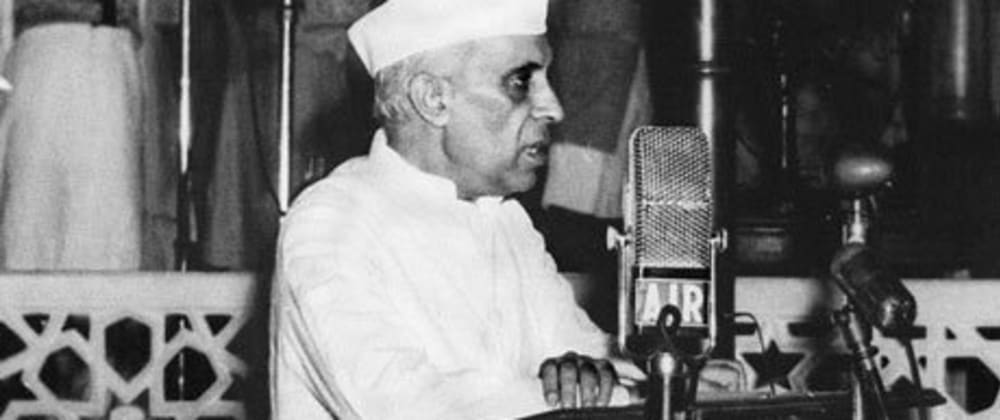
It's midnight, August 14-15, 1947. The Constituent Assembly Hall, New Delhi. The chamber is packed. Every seat taken. The galleries are full. Outside, millions wait.
Jawaharlal Nehru rises. He speaks:
At the stroke of the midnight hour, when the world sleeps, India will awake to life and freedom. A moment comes, which comes but rarely in history, when we step out from the old to the new, when an age ends, and when the soul of a nation, long suppressed, finds utterance.
The tricolor rises. The conch shell blows. India is free.
But Gandhi is not in Delhi. He is in Calcutta — in a Muslim neighborhood, fasting and praying, trying to stop the killing. When asked about celebrations, he says:
"I cannot rejoice on August 15 when India is being torn apart."
At the same hour, across the new border, trains arrive in Lahore and Amritsar. They are full of corpses. Entire trainloads — men, women, children — slaughtered in transit. Hindu refugees heading east. Muslim refugees heading west. Both murdered by the other side.
Freedom and genocide. On the same midnight. On the same subcontinent.
The Mountbatten Plan — 73 Days to Divide a Subcontinent
THE FINAL ACT:

FEBRUARY 1947:
  British PM Clement Attlee announces:
  "Britain will leave India by JUNE 1948."

  Lord Mountbatten arrives as last Viceroy
  (March 22, 1947)
  Mandate: Transfer power and get out.

MOUNTBATTEN'S ASSESSMENT:
  → Communal violence EVERYWHERE
  → Congress and League CANNOT agree
  → United India: IMPOSSIBLE
  → The only option: PARTITION

THE MOUNTBATTEN PLAN (June 3, 1947):
  → India to be divided into TWO nations
  → India (Hindu-majority)
  → Pakistan (Muslim-majority, in TWO WINGS:
    West Pakistan and East Pakistan)
  → Provinces decide by vote
  → Princely states choose which nation to join
  → Date: AUGUST 15, 1947

  Original deadline: June 1948
  Mountbatten moved it up by 10 MONTHS.

  Why? "If we wait, the violence will be worse."

  73 DAYS to divide a subcontinent.
  73 days to draw borders through
  the lives of 400 million people.
The Radcliffe Line — A Man Who Had Never Been to India
THE BORDER:

SIR CYRIL RADCLIFFE:
  British lawyer. Never visited India.
  Never visited South Asia AT ALL.

  Given 5 WEEKS to draw the border.
  Two boundary commissions:
  → Punjab (west)
  → Bengal (east)

  His tools: outdated maps, census data,
  and impossible instructions:
  "Divide by Muslim/Hindu majority —
   but also consider 'other factors.'"

THE PROBLEM:
  Punjab: Hindus, Muslims, Sikhs MIXED
  → Lahore: Muslim majority, but Sikh holy sites
  → Amritsar: Hindu/Sikh majority, but Muslims nearby
  → Villages: one side of the street Hindu,
    other side Muslim

  Bengal: Similar mixing
  → Calcutta: Hindu majority, surrounded by
    Muslim-majority districts

  You CANNOT draw a clean line.
  Every line destroys someone's home.

THE RADCLIFFE LINE:
  Published: AUGUST 17 — two days AFTER independence
  (Mountbatten delayed it to avoid ruining
  the independence celebrations)

  When the line was published:
  → Entire communities discovered overnight
    that they were in the "wrong" country
  → Villages split in half
  → Families divided
  → The exodus began — those who hadn't
    already started running
The Great Migration — 15 Million
THE LARGEST MASS MIGRATION IN HUMAN HISTORY:

THE NUMBERS:
  → 15 MILLION people displaced
  → 1-2 MILLION killed
  → 75,000+ women abducted on BOTH sides
  → Refugee columns: 50-60 miles long
  → Entire cities emptied and refilled

THE HORROR:

TRAINS:
  → "Ghost trains" arrive at stations
  → Full of corpses — every passenger murdered
  → Messages painted on the carriages:
    "A gift from Pakistan" / "A gift from India"
  → Drivers kept driving — afraid to stop
  → Bodies thrown from moving trains

REFUGEE COLUMNS:
  → Millions walking — carrying what they could
  → Attacked en route by mobs of the other religion
  → Women jumped into wells to avoid abduction
  → Children lost in the chaos — never found
  → Sikh columns from West Punjab heading east
  → Muslim columns from East Punjab heading west
  → Both attacked. Both massacred.

PUNJAB:
  The worst violence was in Punjab —
  divided between India and Pakistan.
  → Sikh, Hindu, Muslim — all perpetrators
  → All victims
  → Canal waters ran red
  → The province that was most mixed
    suffered the most

BENGAL:
  Less violence than Punjab
  (partly due to Gandhi's presence in Calcutta)
  But millions displaced
  → Refugees poured into Calcutta for decades
  → West Bengal's refugee crisis lasted until the 1970s
The Leaders at Midnight
WHERE THEY WERE ON AUGUST 15, 1947:

NEHRU:
  In Delhi. Gives "Tryst with Destiny" speech.
  Becomes first Prime Minister.
  Believes India's future is bright.
  (He doesn't yet know how bad the violence will get.)

GANDHI:
  In Calcutta. NOT celebrating.
  Living in a Muslim house in Beliaghata.
  Fasting. Praying.
  "You have come to congratulate me?
   Congratulate me when Hindus and Muslims
   live in peace."
  His presence in Calcutta saves the city:
  Mountbatten calls it "the One-Man
  Boundary Force."

JINNAH:
  In Karachi. Becomes Governor-General of Pakistan.
  Gets his country. He is already dying
  of tuberculosis (kept secret).
  Will live 13 more months.
  Pakistan without Jinnah will descend
  into military coups within a decade.

MOUNTBATTEN:
  Governor-General of independent India
  (at Nehru's request — controversial).
  Celebrates with champagne.
  Later accused of pro-India bias
  in drawing the Radcliffe Line.

PATEL:
  Already working on integrating
  the 562 princely states.
  While others celebrate, he is writing
  letters to maharajas.
  The real work of nation-building
  starts on August 16.

AMBEDKAR:
  Appointed Law Minister by Nehru.
  Will chair the Constitution Drafting Committee.
  The man who fought against Congress
  is now building the nation's legal foundation.
  The irony is deliberate — Nehru's finest decision.
The Princely States — 562 Ticking Bombs
THE FORGOTTEN CRISIS:

562 PRINCELY STATES:
  → Technically independent under the Crown
  → Mountbatten Plan: free to join India or Pakistan
    or remain independent
  → Some are the size of France (Hyderabad)
  → Some are the size of a village

  Most join India quietly.
  THREE DON'T:

  JUNAGADH: Muslim ruler, Hindu population
  → Ruler joins Pakistan
  → India conducts plebiscite → joins India

  HYDERABAD: Muslim ruler (Nizam), Hindu majority
  → Nizam wants independence
  → Patel sends the army (1948): "Operation Polo"
  → Hyderabad joins India

  KASHMIR: Hindu ruler (Hari Singh), Muslim majority
  → Ruler delays decision
  → Pakistan sends tribal raiders (October 1947)
  → Ruler signs Instrument of Accession to India
  → India sends army
  → War. Ceasefire line. Unresolved TO THIS DAY.

  Kashmir is the wound that never healed.
  Every India-Pakistan conflict traces back
  to October 1947.
Why This Moment Matters
- Freedom came at the worst possible price. 200 years of colonial rule ended. 1-2 million died in the process. 15 million lost everything. Independence and genocide were born on the same midnight.
- Mountbatten's haste killed millions. 73 days to partition a subcontinent. A border drawn by a man who'd never seen India. The rushed timeline meant no preparation, no protection, no mercy.
- The trains are seared into memory. Ghost trains full of corpses. Messages on blood-stained carriages. This is the founding trauma of both India and Pakistan — the original sin that neither nation has processed.
- Gandhi's moral authority peaked — and broke. He saved Calcutta single-handedly. But he couldn't save Punjab. He couldn't stop partition. The man who led millions couldn't stop the hatred. Five months later, he was dead.
- Kashmir became permanent. The one state whose accession was contested became the source of three wars, a nuclear standoff, and 77 years of unresolved conflict. The Radcliffe Line ended. The Kashmir question didn't.
At midnight on August 15, 1947, Nehru spoke of freedom while trains of corpses crossed the border. That is the founding paradox of modern India — a nation born in the most beautiful speech and the most terrible violence, on the same night, under the same sky.
Part of the Modern History series. This article covers the twenty-sixth event in the Complete Timeline Overview timeline.


Top comments (0)