


Imagine This...
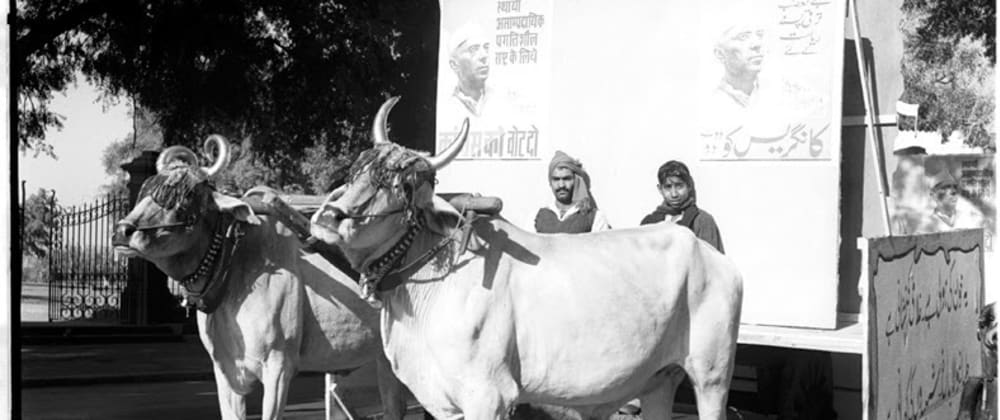
It's October 25, 1951. The first phase of voting begins. In a village in Madhya Pradesh, a woman who has never held a pen walks into a polling booth. She cannot read the candidates' names. So the Election Commission has given each party a symbol — the Congress has a pair of bullocks, the Socialists have a banyan tree, the Communists have a sickle and wheat sheaf.
She looks at the symbols. She recognizes the bullocks — she has seen them on Congress posters. She presses her thumb into the ink pad and stamps next to the symbol.
Her vote counts exactly as much as Jawaharlal Nehru's.
Across India, 173 million people are eligible to vote. 85% cannot read or write. The British had said Indians weren't ready for democracy. Western observers predicted collapse. The American press wondered if India would survive its first election.
Sukumar Sen — India's first Chief Election Commissioner — has spent two years preparing for this moment. He has organized 224,000 polling booths, trained 16,500 clerks just to type the electoral rolls, printed 56 million ballot papers, and arranged transport ranging from jeeps to elephants to boats.
The election takes four months — from October 1951 to February 1952. When the results come in:
46% turnout. Congress wins 364 of 489 seats. Nehru is Prime Minister with a massive mandate.
The world is astonished. Democracy works in India.
This election is an act of faith. It is a tremendous experiment in democracy. If it succeeds, it will prove that democracy is not the preserve of the literate and the affluent.
The Scale — A Logistical Miracle
THE NUMBERS:

ELIGIBLE VOTERS: 173 million
  → More than the ENTIRE population of
    the United States at the time
  → 85% illiterate
  → Most had NEVER voted before
  → Many had never seen a ballot paper
  → Women in some regions had no surnames
    (listed as "wife of" or "mother of")

ELECTORAL ROLLS:
  → 16,500 clerks hired just to TYPE the rolls
  → 224,000 polling booths set up
  → 56 million ballot papers printed
  → Symbols assigned to every party
    (for illiterate voters)
  → Separate ballot boxes for each candidate
    (voters dropped a blank ballot into
    the box of their chosen candidate)

LOGISTICS:
  → Ballot boxes carried by ELEPHANT
    through jungles of Assam and Orissa
  → Carried by BOAT across rivers in Kerala
    and Bengal
  → Carried by MULE through Himalayan passes
  → Carried on FOOT through tribal areas
  → Some polling stations required 3-day treks
  → Arctic cold in Ladakh, tropical heat in Madras

  Time: October 25, 1951 → February 21, 1952
  (4 months — phased voting across the country)

THE MAN BEHIND IT:
  SUKUMAR SEN — ICS officer, mathematician
  → Designed the entire electoral system
  → Created the symbol-based ballot for
    illiterate voters
  → Insisted on absolute neutrality
  → Later invited by Sudan and Egypt
    to help conduct THEIR elections
  → India's democracy was SO well-run
    that other nations copied it
The Parties and the Contest
THE POLITICAL LANDSCAPE (1951):

INDIAN NATIONAL CONGRESS:
  Leader: Jawaharlal Nehru
  Symbol: Pair of bullocks (yoked)
  Position: Center-left, secular, dominant
  The party of the freedom struggle.
  Nehru = living legend, Gandhian heir.
  Expected to win. The question: by how much?

COMMUNIST PARTY OF INDIA (CPI):
  Position: Far left, pro-Soviet
  Strong in: Kerala, Bengal, Andhra, Telangana
  Had led the TELANGANA REBELLION (1946-51)
    — armed peasant uprising against the Nizam
  Controversial: opposed Quit India (1942)

SOCIALIST PARTY:
  Leaders: Jayaprakash Narayan, Ram Manohar Lohia
  Position: Left, Gandhian socialism
  Former Congress members who split
  Respected but organizationally weak

BHARATIYA JANA SANGH:
  Leader: Syama Prasad Mookerjee
  Position: Hindu nationalism
  Founded 1951 — the precursor of today's BJP
  First election: limited impact

HINDU MAHASABHA:
  Weakened after Gandhi's assassination
  Discredited but still contesting

KISAN MAZDOOR PRAJA PARTY (KMPP):
  Leader: Acharya Kripalani
  Position: Center, Gandhian
  Former Congress president

SCHEDULED CASTE FEDERATION:
  Leader: B.R. Ambedkar
  Position: Dalit rights, social justice
  Ambedkar HIMSELF contested — and LOST
  (from Bombay North)
  The architect of the Constitution
  was defeated in the first election
  under that Constitution.

  (He later entered Parliament
  through a Rajya Sabha seat from Bengal.)

INDEPENDENTS:
  533 independent candidates
  A vibrant, chaotic democratic landscape
The Results — Congress Dominates
THE FIRST RESULTS:

LOK SABHA (489 seats):
  Congress:           364 seats (74.4%)
                      45% of popular vote
  CPI:                16 seats
  Socialist Party:    12 seats
  KMPP:               9 seats
  Jana Sangh:         3 seats
  Hindu Mahasabha:    4 seats
  Others/Independents: 81 seats

STATE ASSEMBLIES:
  Congress won majority in almost EVERY state
  Exceptions:
  → Travancore-Cochin: no clear majority
  → Madras: Congress formed government
    but faced strong opposition
  → PEPSU: instability

TURNOUT: 45.7%
  → Remarkable for a first election
  → In a country where 85% can't read
  → Where many voters had NEVER seen a ballot

KEY RESULTS:
  → Nehru: MASSIVE mandate
    India's first elected PM
  → Ambedkar: LOST his Bombay seat
    Defeated by a Congress candidate
  → Syama Prasad Mookerjee: Won
    (but Jana Sangh got only 3 seats)
  → CPI emerged as main opposition in some states
  → Socialists disappointed

THE FIRST-PAST-THE-POST EFFECT:
  Congress won 45% of votes
  but 74% of seats.
  This pattern — minority vote, majority seats —
  would define Indian elections for decades.
What the World Said
THE GLOBAL REACTION:

WESTERN PRESS (before):
  "Can illiterate masses actually vote?"
  "India will collapse into chaos."
  "Democracy requires literacy and wealth."
  "This is an experiment doomed to fail."

WESTERN PRESS (after):
  "A triumph of organization and faith."
  "India has proved democracy is universal."
  "The world's most unlikely democracy works."

THE SIGNIFICANCE:
  1951 was the COLD WAR.
  → The Soviet model: one party, industrialize fast
  → The American model: democracy + capitalism
  → Most post-colonial nations chose strongmen:
    China (Mao), Egypt (Nasser), Indonesia (Sukarno)
    → all moved toward authoritarianism

  India chose ELECTIONS.
  Not because it was easy.
  Because Nehru, Ambedkar, and the founders
  BELIEVED in democracy — even when it was
  inconvenient, messy, and slow.

  The first election proved them right.
  India could govern itself.
  Not perfectly. But democratically.
Why This Moment Matters
- It was the ultimate answer to colonialism. "Indians can't govern themselves" — the excuse for 200 years of British rule. In 1952, 173 million Indians voted in a free and fair election. The excuse was annihilated.
- The symbol system was genius. Illiteracy could have killed democracy. Instead, Sukumar Sen invented a system where pictures replaced words. A farmer who couldn't spell his name could choose his government. This innovation still exists on Indian ballots.
- Ambedkar's defeat was democracy's proof. The man who wrote the Constitution lost his own election. That's not a failure — that's proof the system works. Nobody is above the ballot. Not even the architect.
- Congress's dominance set the pattern. 74% of seats with 45% of votes. The first-past-the-post system gave Congress supermajorities for decades. This "Congress system" defined Indian politics until 1977.
- India's democracy inspired the world. Sukumar Sen was invited to organize elections in other countries. India's electoral model — symbols for the illiterate, phased voting for logistics, independent Election Commission — became a template for developing democracies worldwide.
173 million people. 85% illiterate. Elephants carrying ballot boxes through jungles. Boats carrying them across rivers. Women voting for the first time in history. And when it was over, a nation that every expert said would fail had conducted the largest democratic exercise in human history — and proven that democracy belongs to everyone, not just the literate and the wealthy.
The Complete Timeline Overview ends here. From the Battle of Plassey (1757) to the First General Elections (1952) — 195 years. From a trading company's coup to the world's largest democracy. The story of modern India.
Part of the Modern History series. This article covers the thirty-first and final event in the Complete Timeline Overview timeline.


Top comments (1)
ok